
On My Mama (A Tenderheaded Reflection)
For the dysregulated girlies (now mamas) whose shoulders scrunched up when the hot comb got too close…

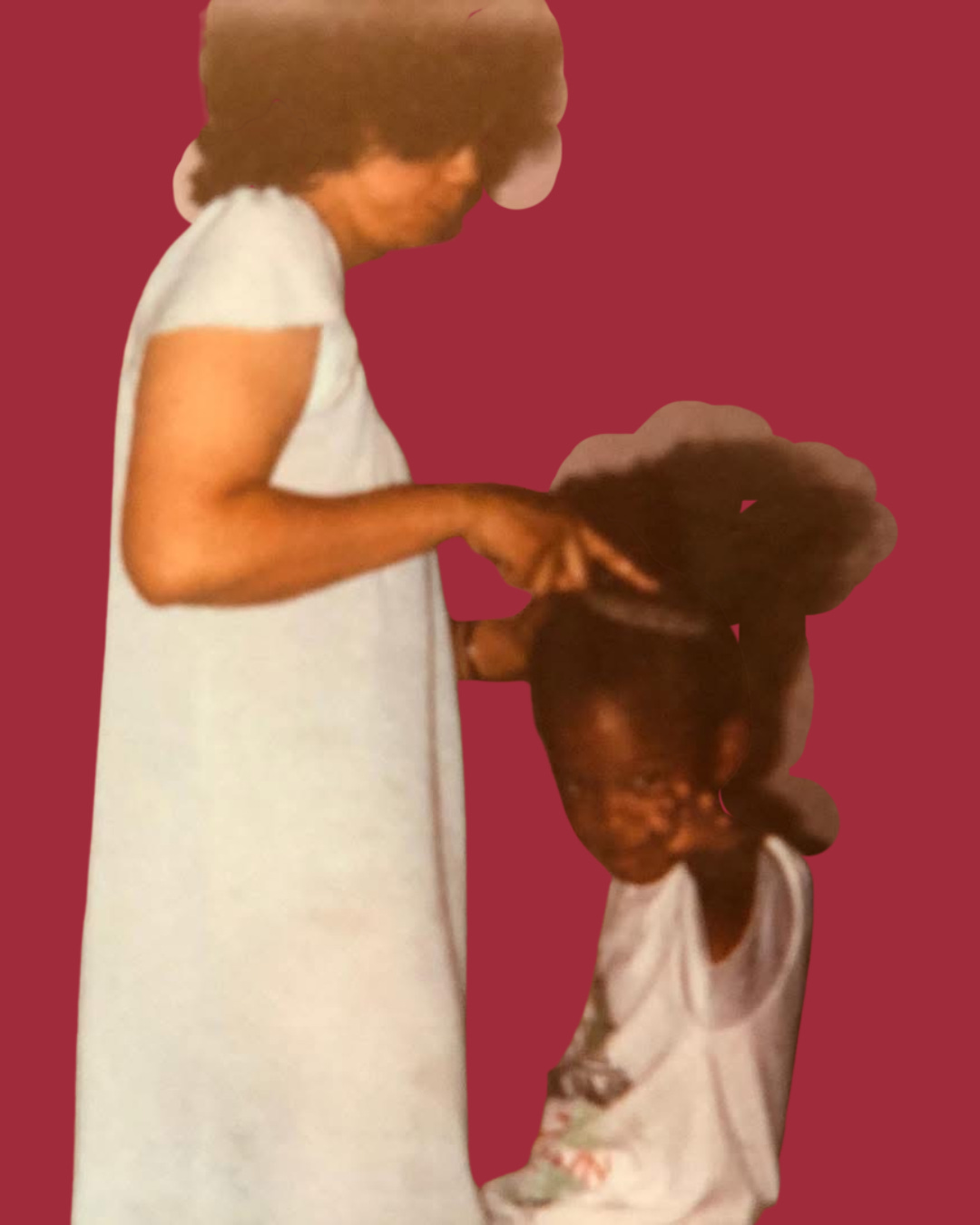
Photo: Me and my mama circa 1989/90
The Abstract
“When they say ‘She get it from her mama’, I’ma say you fuckin’ right..” - Victoria Monet, “On My Mama”
I was not the first, or only, little Black girl to ever be called tenderheaded in the history of Black girlhood. Like rocking bubbles and clips on some dookie braids held together by Pink Lotion, being crowned as tenderheaded was a Black girl hair care rite of passage, typically placed on you by your mama. To be tenderheaded meant being sensitive, unable to easily handle or sit still through the tugs of complexity and pressure that were naturally part of your DNA. You might cry easily at the touch of a brush slicking down your baby hairs or the yank of a comb detangling the knots that formed, only to be met with “You better sit still” or “I’ll give you something to cry about” – the shared language of Black mamas with places to go, things to do, frayed nerves (and you were on her last one), and limited patience for any (developmentally appropriate) reaction to pain.
I have had a complicated relationship with my mother, with my perception of what I saw as meanness, coldness, and impatience. It actually became a running joke in our house as she would often respond when called with an annoyed “Yesssss.” A few weeks ago, I caught myself responding in that same way to my own children, and it stopped me in my tracks. It has only been through my own experience as a mother that I have been able to look at her with new eyes, with a deeper understanding that being tenderheaded sometimes ain’t just about your hair. It’s also a call to care for our nervous systems.
The Theory
What does it mean for an entire generation of parents to be providing support and emotional safety for big emotions when they, themselves, were never given the space? - Dr. Amber Thornton, A Parent’s Guide to Self-Regulation
I came across Dr. Amber Thornton’s book, A Parent’s Guide to Self-Regulation, after viewing a post by Danielle Bayard Jackson on IG. I ran right to my Libby app and checked it out because if there is one thing that I am least proud of as a mother, it’s my lack of patience. While I am physically my mother’s twin, my mother’s lack of patience is the one quality that I did not want to inherit. However, when I replay the interactions with my children that I wish I could change, they are often the imperfect moments where I was too short and didn’t gentle parent the way all the perfect social media mamas do. It is also the constant reminder that I am more like my mother than I ever cared to realize…and that ain’t necessarily either of our faults. Dr. Thornton talks about how dysregulation shows up in so many different ways and is caused by a variety of factors and triggers that accumulate over time, whether it be lack of sleep, overworking, or people pleasing (see The Art of Loving (Myself) and Boundaries Are a Love Language). She notes that from the start of the day to bedtime, and most definitely the weekend, there are multiple opportunities for parents to become dysregulated.
“..when you became a parent, what used to be a gentle start to the day became aggressively harsher and could very well have felt like a huge electric jolt. It’s possible that you’re no longer afforded the time you once had to yourself in the mornings, as many children wake early and have needs that begin instantly. It’s also likely that you’re having to stretch an already limited amount of time to make sure that everyone is ready and out of the door at a very specific time. Double the dysregulation points if your child is not yet ready for independence and requires 100% of your assistance. Special mention for the parents whose children are independent but still rely on your executive functioning (which is likely already compromised) to get from A to Z at 6 a.m..” (Thornton, p. 56)
No matter how much you plan for all of the possible outcomes to try and even make these times of the day run smoothly, the dysregulation comes from the complete opposite…the things you cannot control. And isn’t that what having kids is all about…releasing control? Because, let’s be real, it’s really their house, their show…and we just live in it.
But what does it mean once you recognize and see the dysregulation while also reconciling with the fact that you were not necessarily taught the skills to navigate while overstimulated, overworked, sleep deprived, and all of the other things? What does it especially mean for Black mothers who are also navigating what it is to not just exist as Black women in our current state but to also raise Black babies in the midst of…all…of…this? The endless news and images of violence, of babies being ripped from their parents, and detention centers are traumatizing. For Black folks, this ain’t new to us. Dr. Bettina Love in her 2019 text, We Want To Do More Than Survive, stated “Black mothers fear for all Black life and for their own too. I was mothering in fear. I am mothering under White rage. How do you mother or father or love under White rage? How do you protect when White rage is always raging? Your number one job as a parent is to protect your children from harm but how do you do that when you cannot protect yourself?”
How do we regulate when we are not just dysregulated from the morning and bedtime routines but the current state of our society?
The Practice
“Let Mama let you know
Mama’s still tryin’
I can’t get no days off
I don’t get no days off
Truly, I’m feelin’ it
I had to say that thing twice...”
Beyonce, “Bigger”
I think my mother was tenderheaded too. I don’t mean the tenderheaded of having a sensitive scalp. I mean I think she too had strong reactions to the tug of the complexities of being a working mother and raising two little Black girls. I think she felt the pressure of getting it “right”, of not having us go down “the wrong path.” I think she was more sensitive than cold, mean, or impatient. I KNOW she was sleep deprived because that Wicked Witch kept me running into their room many a night. I think she was tired and overworked and overstimulated and didn’t get a break, at least not the types of breaks I’ve had the opportunity to give myself. While she wasn’t a single parent, she didn’t get a night off, especially with my dad working nights. She didn’t leave the country for a Caribbean getaway. She didn’t go to concerts or dinners with friends. She was also operating from the experiences, good and bad, of her own childhood. She was doing the best that she could with what she had (Mariah voice).
In addition to her PCR (Practical, Conscious, Realistic) Framework, Thornton proposes reparenting as a solution for dysregulation, addressing the issues and wounds from childhood that surface in you as a parent. For example, one of the causes of dysregulation is being overworked, something that I know I tend to do as a result of being called lazy by my parents when I was a teenager. I think that I have spent the last 25 years subconsciously trying to prove that I’m not lazy by overworking. That same overworking leads to trying to do it all and not recognizing the limitations of my physical and mental capacity. And the truth of the matter is that, in this season, I have to be mindful of my capacity so that my children are not harmed at the expense of those childhood wounds. That same overworking impacts my sleep (one of the root causes Thornton mentions) and puts me in a constant race to try to jam things in…a constant race against time (sings to self…“Why do you write like you’re running out of time?”).
So what…now what? What does that look like? It looks like going to bed at a decent hour, not doom scrolling or catching up on tv shows before bed so that I can actually get a good night’s rest. It looks like saying “no” (It’s giving theme…y’all know I’m trying) more often to things that I know will push me past my capacity. This ain’t the early 20s body that was able to pull all nighters in the computer lab and make it to class in the morning. It looks like pausing, taking a breath, and, as Thornton suggests, reminding myself of my ultimate goal for my children…which is their happiness. I cannot reach that ultimate goal if I don’t tend to the things that lead to my dysregulation. All of these things impact my babies, and, while dysregulation stems from those things that are out of our control, these are things that I know I can actively work on so that they see me not just as tenderheaded but also tenderhearted.
Citing The Theory and The Practice
Knowles-Carter, B. (2019). Bigger [Audio recording].
Love, B. (2019). We want to do more than survive: Abolitionist teaching and the pursuit of educational freedom. Beacon Press.
Monet, V. (2023). On My Mama [Audio recording].
Thornton, A. (2024). A parent’s guide to self-regulation: A practical framework for breaking the cycle of dysregulation and mastering emotions for parents and children (1st ed). Ulysses Press.